Sunday, January 21, 2018

AHA! The Fibonacci Sequence!

Much like the discoverer of the Fibonacci Sequence, the Navigators and the Dragons came together and became observers. We went on a QUEST to discover what was similar about all the different items from nature that had been placed around the room. 

We took notes and drew pictures of seashells and starfish.

There were pictures of galaxies.

There were lots of different flowers...

...and pineapples, pine cones. and cauliflower.

We really had to compare and think.

How are they the same?

What is the "common denominator"?


We noticed spikes, colors, and patterns.
We noticed that the pineapple and the pine cone look very similar.

And then we noticed SPIRALS! 
AHA! Most of them have spirals!


We read this book, Blockhead, the Life of Fibonacci, and noticed that he, too, noticed the spiral pattern in nature, along with a sequence of numbers.

We looked at the sequence and saw the pattern.
Another AHA moment!

The kids then get to choose what they'd like to work on.

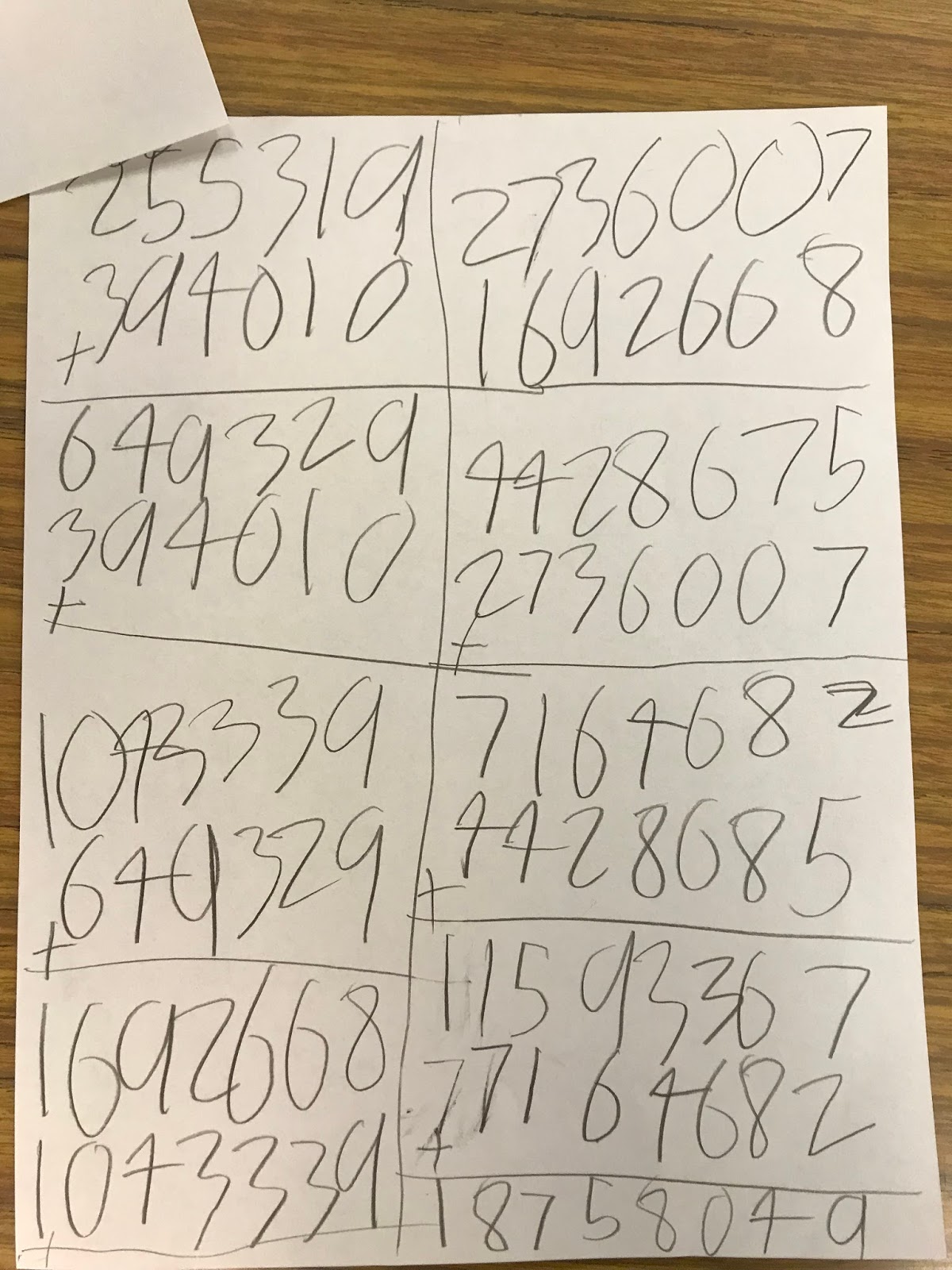
Writing the number sequence as far as they can:


Drawing the spiral:


Taking it even farther on graph paper: 


Counting the spirals on a sunflower. The answer? a Fibonacci number!


This was inquiry based instruction at its finest--the students asked the questions, did the observations, and discovered for themselves what Leonardo Fibonacci discovered about 850 years ago.
He could have been a Seabury Student!

Wednesday, January 17, 2018

We're Swimmers!

The students at Seabury School have a yearly opportunity to take swimming lessons during the school day as part of our PE curriculum. How awesome is that!? And how convenient and beautiful is our local community athletic center, 
the Center at Norpoint.

Thank you, Norpoint, for partnering with us on this fun, educational, healthy, important endeavor, learning how to swim! 


Thursday, January 11, 2018

Inventions: Reverse Engineering


One way to discover how something works is to take it apart. 

So we got out our screwdrivers and began the task of disassembling a variety of wind-up toys. 


First of all, we took a close look at the outside of the toy.

"It moves its arms and legs. This is what the winder looks like."


We wondered what the inside looked like and how it worked.


Then we slowly started to open up the toys, drawing each part as it came apart. 


We found a white box inside and had to pry it open.


This is what we found inside!


Comments heard during this activity:
  • "I told you that this was one big yellow piece."
  • "I was not expecting that there would be so much room and just a little thing inside."
  • "I have a tool box at my Grandma's house."
  • "I'm not a master with a screw driver but I know Lefty Loosey."
  • "It comes with wheels."
  • "Those are gears!"
  • "Mine has 5 gears!"
  • "Can we put them back together?"
  • "What? There is something inside that we have to open?"
  • "Maybe there's something inside that and something inside that and...."
  • "There's sheet metal inside!"
  • "It's like a spring." 
  • "It's wound up with the winder. Look!"
  • "Can you straighten it?"
  • "Let's try this."
  • I didn't know this is how a wind-up toy works!"
  • "Man, this is so incredible."
  • "This is the best day ever."

So many lessons learned. Here are a few:
  • Prediction
  • Observation
  • Small motor skills
  • Drawing and labeling one's findings
  • Collaboration
  • Analytical/critical thinking skills
  • How a wind-up toy works
  • Inspiration for making our own inventions?


Wednesday, January 10, 2018

S.C.A.M.P.E.R.

To get the creative, invention juices flowing, the Navigators have done several mind stretching activities. We started with a whisk.

What else can you do with an ordinary kitchen whisk?


The creative ideas start to flow. It can be used as a:


  • microphone
  • flinger
  • spaghetti spinner
  • idea light bulb
  • top
  • spanker
  • Harry Potter wand
  • instrument
  • tornado
  • wing
  • flame thrower
  • drumstick
  • sword
  • bouncy toy
  • head massage (if you cut the ends)
  • blush putter onner
  • hidden compartment
  • dubbing wand
  • hair curler
  • baseball bat
  • bell
  • earring remover
  • cake batter mixer
  • whip
  • rat catcher
  • arrow
  • and more

What if we modify it? 

Introducing S.C.A.M.P.E.R., a way of stretching our ideas to come up with even more innovative, inventive ideas.

S. Substitute: 
What if we filled a whisk with mirrors and hung it from the ceiling? a disco ball!


C. Combine: 
What if we combined three whisks together? a propeller!


A: Adapt:
What if we cut the top and put crayons in it? a crayon holder!


M: Modify: What if we tie two whisks together? A double sided, do-two-jobs-at-once, whisk!


What if we put a star on it? A fairy wand!


P: Parody: What if we do something to make it funny? a spanker!


E: Eliminate: What if we take away the tips and the handle? A scrubby!


R: Rearrange: What could you use it for if you bent it? ____________ (fill in the blank!)


Once the creative juices started flowing, the ideas started gushing! So many things to invent! Which should we start with first?!


Stay tuned....


Tuesday, January 9, 2018

Introducing INVENTIONS


Here's a sneak peak into how we introduce topics 
at Seabury School. 

We often use the Frayer Model to define what an invention is and what it is not. 
These are some of the ideas the first and second graders came up with.

Question storming is a great way to investigate a topic. Here we are asking about Mrs. Maitlen's socks! Fits perfectly with inquiry based learning. 

*****

Did I mention that Mrs. Maitlen and I attended an Invent Washington class in the summer and are excited about inventions?


Innovation through Inspiration!

The goal of Invent Washington to have "every child in every school in Washington State
to have the opportunity to become an inventor and entrepreneur
and let their passions guide them through this journey!"


We're on a quest to discover problems that need inventive solutions!

And we're excited to come up with ideas 
for our upcoming Invention Convention!


First Grade-isms

A first grader recites 200+ digits of pi!