Friday, May 4, 2018

A Hands-On Lesson On Bones

Dr. Jason Grassbaugh, an orthopedic surgeon at Madigan Army Medical Center, came and gave us an up close and personal, very hands-on experience with BROKEN BONES!

Getting ready for surgery includes x-rays and lead aprons. 

"Those x-rays look familiar," says Mrs. Towne.
 (Yes, she broke her arm and had a plate put in this year. PERFECT for a lesson on bones!) 


Students getting ready for surgery, including astronaut looking face masks in case there is any splashing. Everything has to be covered. 


A student/patient getting ready for surgery. Everything needs to be sterile. 

The antiseptic soap tickles!
 (And we learn later that the tape hurts when it is ripped off. Ouch!!!)

We learn the "nuts and bolts" of putting a rod on a broken bone. 

This poor puppy needs some sutures. 
Dr. Grassbaugh can tie a knot with one hand!

A fellow student needs a splint. 

The wrap goes around and around. Not too tight!

These broken arms are set and will take 3-6 weeks to heal. 

Dr. Grassbaugh's daughter is a great helper. 

Questions?
Yes! Tons of really thoughtful, knowledgeable, insightful questions.


As usual, we are grateful for this unique opportunity to learn about bones from an expert in the field. Thank you, Dr. Grassbaugh, for coming and sharing your knowledge, your skill, and your passion to the first and second graders at Seabury School. 


Sunday, April 29, 2018

Shining Bright at the 2018 Harry Potter Themed Seabury Auction

Official Owl Post:

Thanks for joining us for
Auction 2018 "The Magic of Learning"!!


The Navigators' auction project was a hit at this year's Harry Potter themed gala. And it was all for a good cause:

OUR SCHOOL LIBRARY!


Becky Young, librarian & communications specialist

“You have to write the book that wants to be written. And if the book will be too difficult for grown-ups, then you write it for children.” 
– Madeleine L'Engle


We know our great library will become even better!
Thank you, Ms Becky, for your many hours and years of finding good books for each student. You well deserve the Crystal Award.


Here's our lamp project:

It evolved from this...


to this!


The Process: Each student brought toys from home.

Planning

Sanding and gluing


Viewmaster, Matchbox car, Ninja turtle, Paw Patrol, Furbie, Disney Princess...


Fidget spinner, Playmobil, action figure, plastic whistle...


Ready and excited to spray


Sssssppprrray


Try not to breathe it.


A little more over here.


We lit up the stage!


Mrs. Maitlen and Mrs. Towne always have fun together. 
Here we are both dressed up as Professor McGonagall. 
Twinsies! 


Thank you, parents, for all your volunteer hours 
that make such an event and such a school possible.


Saturday, April 28, 2018

Determination and Eyeballs

Having read the biography Helen Keller by Margaret Davidson, we have gained a greater appreciation for the sense of sight and for the determination (our word of the week) of someone with disabilities.

 One of the Navigator's moms is a doctor and came to our class to teach us more about our wonderful sense of sight. 

Ready for our dissection of a cow eyeball


A pupil learning about pupils (more new words)  


Some are a bit leery about the whole idea.


"Look, there's the hole!"
This student is warming up to the idea.

The Navigators are eager, hands-on learners, literally!


We discover the lens.
"It's hard!"
"I can't squish it."
"Do we have these in our eyes?"
"I don't want to touch it. Okay, I guess I will."


Dissection supplies


Thanks, Dr. Amani, for teaching us about the eyeball and for sharing your passion for helping people through the practice of medicine.


Two boys determined to read Braille


Thank you, Helen Keller, for exemplifying determination. 
We hope to follow your example. 


de·ter·mi·na·tion
dəˌtərməˈnāSH(ə)n/
noun
  1. 1.
    firmness of purpose; resoluteness.

    "he advanced with an unflinching determination"

    synonyms:resolutionresolvewillpower, strength of character, single-mindedness, purposefulness, intentness; 


Monday, April 23, 2018

Making Connections: Neuron Connections, That Is

We have begun our QUEST of understanding things we cannot see - the inside of our bodies. 

We began with the study of the nervous system: the brain, the spinal cord, the peripheral nervous system, and neurons. We made brain map hats and neuron necklaces. We're beginning to make the connections...

During our Friday afternoon Genius Hour, we had the choice to make brain maps and neurons using materials from the MakerSpace. Here's what we came up with:

Here's the entire nervous system made out of Model Magic.

A neuron on the left and a brain map on the right using Model Magic.
(It was Minion Day in honor of our Ms. Clarke, our second grade teacher.)

This is a neuron made out of chenille wires and beads. Note the dendrites and the axon. He made several of these and showed the synapses that occurs between the neurons as they make connections. 

We're beginning to understand but it still is a bit fuzzy. Perhaps we'll understand more as we study the five senses. We start with the sense of hearing.

The sound goes in here...
(Our ear canal model is a long one!)


...and ends up in the brain, going through the auditory NERVE.


We take a voyage into the ear to better understand all the working parts and how sound signals get to the brain. We don't have it entirely correct, but we're on our way. Click above or here to watch our video.

The nervous system is starting to make "sense"! 
Four more senses to go...stay tuned. 


Sunday, April 22, 2018

Raphael's "School of Athens" Ties It All Together

Plato and Aristotle talking about big ideas

At Seabury School, we teach big ideas to little people. The first and second graders are finishing up a study of the Renaissance Period. Coupled with a study of inventions, we have covered higher level, challenging ideas, a perfect challenge for these gifted, highly capable young people. 

In order to do this, the teachers at Seabury use the Blooms Taxonomy of Educational Objectives "inverted pyramid" approach when developing our curriculum.


The chart on the left shows the regular Blooms Taxonomy. 
The chart on the right is the inverted pyramid. 

Research shows that with gifted students, more time should be invested on higher-level activities and objectives--analyzing, evaluating, and creating. For our students, knowledge in itself might not be completely satisfying. 

With this in mind, we are able to study topics that are usually studied much later than first and second grade, topics like the Middle Ages, the Renaissance, and also Inventions, a perfect tie-in to these time periods. 

As we finished up our QUEST to understand these topics, we asked the question, "How do these all fit together?"


We got out a long timeline and made some interesting discoveries.
  • The US hasn't been around that long.
  • The Middle Ages is in the middle of the Ancient History Period (Egypt, Greece and Rome) and the Renaissance.
  • The Middle Ages was a time of survival. Not much time for art.
  • The Renaissance is the rebirth of the Ancient History Period ideas.
  • The Middle Ages was also called the Dark Ages. Now we know why.
  • We learn what BC and AD mean and BCE and CE.
  • There isn't a year "zero".
  • We see where important inventions/inventors fit--Gutenberg, Leonardo da Vinci, Galileo, the Wright Brothers, Thomas Edison, etc.
  • We get excited about studying the Explorers next year!


We then took a close look at Raphael's painting, "The School of Athens." We had a great analytical, evaluative discussion, a discussion that tied together what we've been studying all year.
  • When was this painted?
  • Where is it today?
  • How big is it?
  • Who are these people?
  • When were these people alive?
  • Who were Plato and Aristotle?
  • Even though they were no longer alive, how did they effect Galileo's life? 
  • What are the people doing? Holding? Why do you think they are holding these things? 
  • Do you see Raphael's self portrait?
  • What are the statues of?
  • Notice the perspective of the room. Do you see the vanishing point? How is this different from the paintings from the Middle Ages?


"The School of Athens [1511] represents all the greatest mathematicians, philosophers and scientists from classical antiquity gathered together sharing their ideas and learning from each other.These figures all lived at different times, but here they are gathered together under one roof."
                                                            ~Khan Academy

Check out the interesting (at least to first and second graders 😉) Khan Academy lesson here.


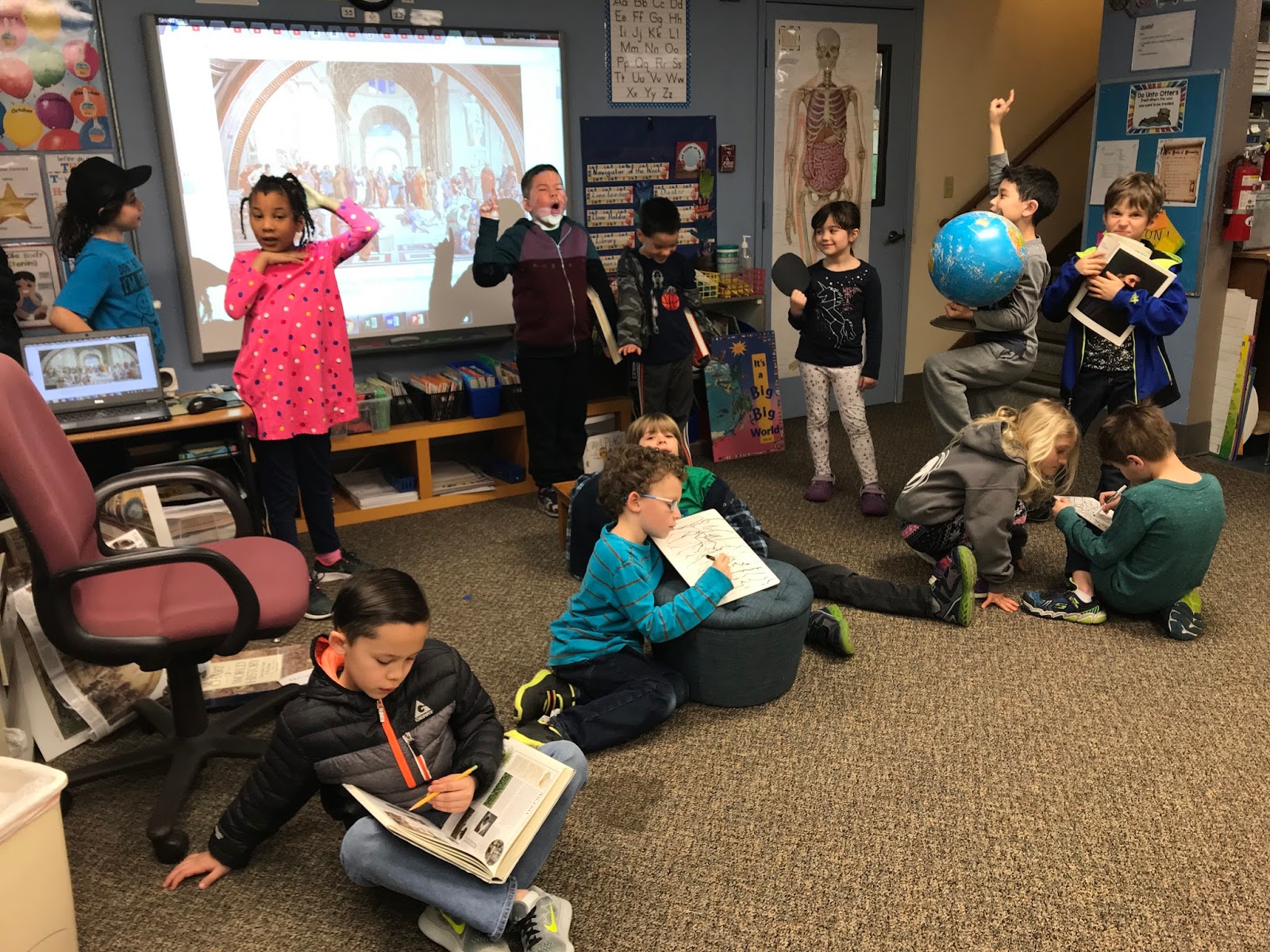
We then got ultra creative (top level of Blooms Inverted Taxonomy!) and recreated the School of Athens in our classroom. 
  • Plato and Aristotle are at the center, Plato on the left pointing up holding his book The Timaeus, Aristotle on the right pointing down holding his book called Ethics
  • Pythagoras holding his big math book
  • Euclid drawing a geometric design with an eager student watching and learning
  • Ptolemy holding the globe
  • Zoroaster holding a terrestrial sphere
  • Diogenes casually sitting on the stairs
  • Heraclitus, the ancient philosopher writing and lost in his own thoughts
  • Students leaning against the wall and in a discussion
  • Raphael himself peaking out on the right hand side

What a rich, exciting, educational QUEST we have been on this year. Most people I talk to say, "I never studied those things until college!" Well, these Seabury first and second graders now have a head start! And they have done a fine job, thank you. Inverted Blooms Taxonomy works!


Saturday, April 21, 2018

Washington State Invention Convention Winners!

For the first time ever, Seabury School sent five students to the Washington State Invention Convention held April 15 at Foss High School. These three first graders all earned a second place huge ribbon for their innovative ideas and their hard work!


His invention was "The Safe Tire", a tire with an interchangeable tread that just might be the answer to highway safety. 


 His invention was the "Ocean Floor Cleaner", something he is quite passionate 
and knowledgeable about.


His invention was the "Flying Car", one of many invention ideas he came up with. 

Click here to see their projects. 


Equipped with the inventor mindset, these kids will always be on the lookout for ways to improve our world. 

Keep an eye on these future world changers!

First Grade-isms

A first grader recites 200+ digits of pi!